
Checking Criminal History in Nags Head
Start with Nags Head Police when one of its officers created the incident or arrest report. Choose the town's general request form when the record may belong to another municipal department or when a written town request best fits. Present custody is checked with Dare County Detention Center, while filed charges and outcomes belong to the North Carolina state courts. The SBI Right to Review is the separate fingerprint-supported path for your own statewide North Carolina repository history.
A Nags Head records search works best when the incident date, victim name, incident type, or report number is known. Those details help Police Administration find the local file and later help the clerk distinguish related court events.
- Ask Nags Head Police Administration for the incident report after allowing the posted processing time.
- Use the Town of Nags Head public-record form and select “Police” for a formal written town request.
- Call Dare County Detention Center to confirm current custody or recent booking status.
- Search the eCourts Portal and obtain authoritative filings from the Dare County Clerk.
- Use the SBI Right to Review only for your own fingerprint-matched North Carolina history.
Nags Head Five-Day Record Window
Nags Head Police advises requesters to allow about five business days before asking for a finished report. A shorter general phrase appears elsewhere in town guidance, so the detailed five-day instruction is the safer planning rule. Reports cost $5. The accepted payment methods documented by the town are cash, personal check, or money order. Police Administrative hours are Monday through Friday, 8:30 a.m. to 5 p.m.
Processing time and public availability are separate questions. Waiting five days does not make the full investigative file public. It gives staff time to complete and route the report. North Carolina law may still protect investigation details, juvenile information, or sensitive victim data. Ask for the public incident or arrest facts if the full narrative cannot be released, and give the date, victim name, event type, or report number so staff can locate the correct Nags Head record.
| Request Point | Nags Head Detail |
|---|---|
| Suggested wait | Allow about five business days |
| Copy fee | $5 |
| Payment | Cash, personal check, or money order |
| Useful keys | Incident date, victim name, incident type, or report number |
Nags Head Police Department Records
The Nags Head Police Department is at 5401 S. Croatan Highway, Nags Head, NC 27959. Call 252-441-6386 during administrative hours for report-copy questions. Dare Central Communications at 252-473-3444 handles nonemergency and after-hours officer contact, while emergencies go to 911. An after-hours call can create a new incident, but it is not a shortcut to a finished report copy.
Police Administration is the town unit behind report processing. The official Administrative Division page is also the source for the image below.
The administrative channel is the direct path for a Nags Head police report, including the local fee, identification details, and expected preparation time.
Nags Head Town Record Form
Nags Head also provides a broad online public-record request form. It is not limited to police files. To route a police record correctly, select “Police” in the department menu and describe the sought record with enough detail for staff to find it. The form asks for the requester's first and last name, street address, city, state, ZIP code, phone, email, a specific records description, department choice, and an electronic-signature acknowledgment.
Address Line 2 is optional. The form includes a typed signature, an email-copy option, reCAPTCHA, and buttons for “Submit” and “Submit and Print.” The town says it will respond within five working days. A response may acknowledge the request, ask for clarification, state a legal limit, or give a production timetable. It does not promise that every record will be produced within five days.
The official Nags Head public-record form is the direct source for the image below.
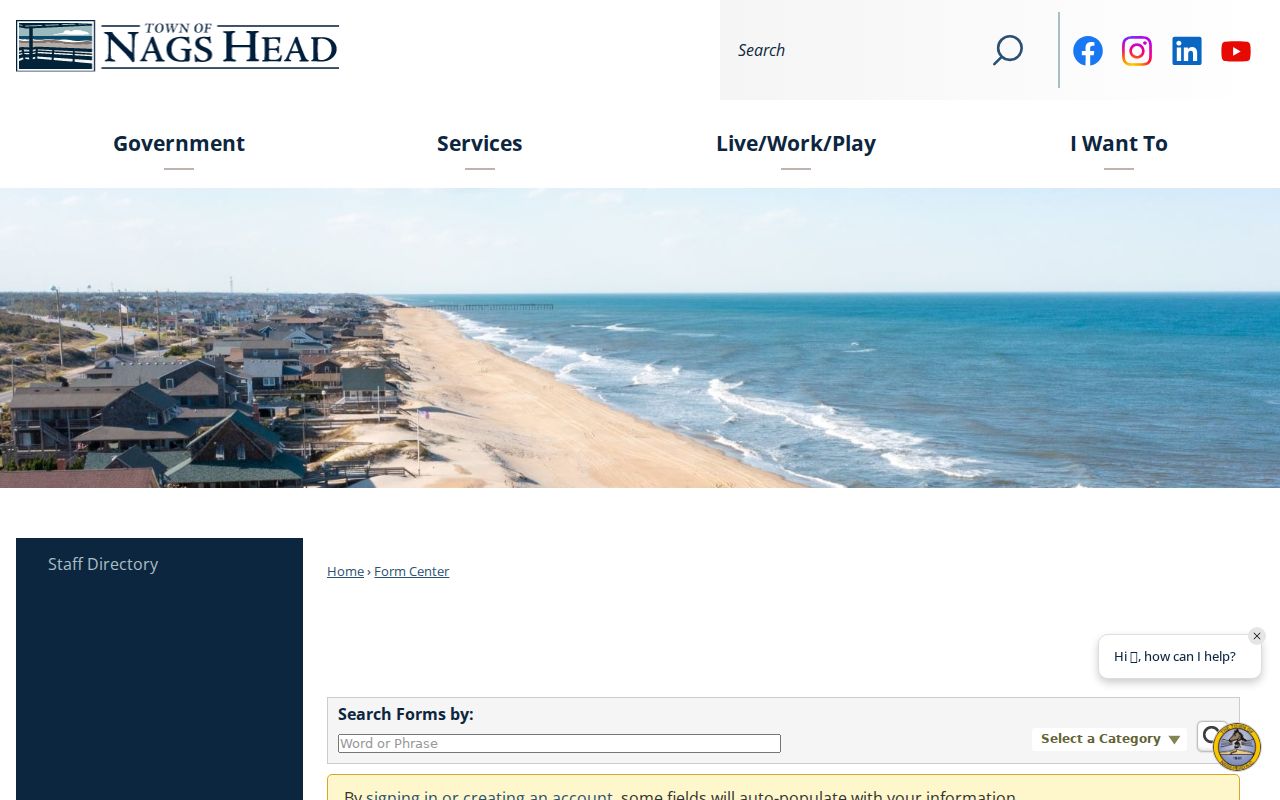
The form view shows why selecting the Police department and writing a precise description are key parts of routing a Nags Head criminal record request.
Nags Head Arrests and Bookings
Nags Head Police creates its enforcement report, but a person taken into custody is booked through the Dare County Detention Center in Manteo. Jail intake creates a separate record with identity, intake time, arresting agency, current charges, fingerprints, photograph, bond data, and custody status. The magistrate at the detention address handles initial judicial process and release conditions. This is why a Nags Head police report and a Dare booking record can describe the same event from different legal roles.
The county did not provide a stable official live jail-roster search in the research inspection. Call Detention at 252-475-9220 to ask about present custody. Bond-process questions go to the magistrate at 252-475-9228. The monthly Sheriff blotter is a selective enforcement summary, not a complete Nags Head arrest feed, and it should not be used as proof of the final court outcome.
Note: Release can change quickly, so confirm current custody directly before traveling to Manteo or arranging a payment.
Nags Head Record Custodian Choice
The first question is not “Where is every criminal record?” It is “Who created this one?” A Nags Head officer's report stays with Nags Head Police. Dare Detention holds the booking file. The magistrate records initial process and release terms. The clerk keeps the court docket and judgment. SBI can hold a fingerprint-supported arrest cycle after a qualifying submission. These offices do not share one public front desk.
Use the artifact's purpose to choose the custodian. An incident report describes the reported event and investigation. An arrest record documents law-enforcement action. A booking record concerns custody. A court case shows prosecution and outcome. If the concern is a current or recent arrest, the county Dare County arrest lookup channels extend beyond the Nags Head report. If the concern is a final disposition, use eCourts and the clerk instead.
- Custodian
- The public office that legally keeps and responds for a record.
- Booking
- The jail intake process, which is not proof of guilt.
- Docket
- The court's ordered history of filings, hearings, and events.
- Disposition
- The recorded outcome of each charge.
Municipal Court Records in Nags Head
Nags Head has no independent municipal criminal court. Town citations and police-originated charges route into Dare County's state courts. District Court handles misdemeanors, traffic and infractions, juvenile cases, and early felony matters. Superior Court hears felony trials. Search the North Carolina eCourts Portal by party name or known record number, then verify the county, location, case number, and each charge's disposition.
The Dare County Clerk of Superior Court is at 962 Marshall C. Collins Drive in Manteo and can be reached at 252-475-5200. Ask the clerk for the actual file when the Portal lacks a charging instrument, judgment, or older document. Public courthouse terminals also support criminal searches by defendant, case number, or victim and witness name under state guidance.
| Court Name | Dare District Court and Dare Superior Court |
|---|---|
| Case Types Heard | Traffic, misdemeanors, preliminary felony matters, and felony trials by division |
| Case Lookup Channel | eCourts Portal, public courthouse terminal, and Dare County Clerk |
| What the Docket Shows | Case number, charge events, calendars, status, dispositions, and judgment data |
| Copies and Fees | Confirm current copy fees with the clerk; the county-only name check is $25 |
Nags Head Coastal Record Jurisdiction
Nags Head sits in a coastal county where the responding badge may change with the exact place and road. A town officer can create one report, the North Carolina State Highway Patrol can hold a highway crash record, and federal rangers can create records for events on federal land. Custody may still run through Dare Detention even when the arresting agency is not Nags Head Police. The court venue may also differ if an event is federal.
Identify the exact location and arresting or responding agency before filing a request. A Nags Head mailing address alone does not prove that the town police own the record. Beach, road, and National Park Service boundaries can make this step especially important on the Outer Banks. If the report came from federal rangers, use that agency's official federal records channel and check the Eastern District of North Carolina for a federal criminal case rather than assuming a Dare state docket.
Jurisdiction check: Confirm the responding agency from the incident number or citation before paying a fee or sending a town request.
Where Nags Head Records Go
Nags Head retains the police report it creates. Dare Detention creates a custody record if booking occurs. The Dare clerk maintains the state prosecution after the charge is filed, and fingerprint-supported arrest data can enter the SBI computerized criminal history. Those layers are linked by names, dates, charge identifiers, and fingerprints, but reporting time can differ between them.
Record flow: Nags Head Police › Dare County Courts › North Carolina State Bureau of Investigation
A new report may be ready at Police Administration before all court events appear online. A booking can end in release before the first search. A later dismissal or conviction belongs in the court disposition, even if the original arrest wording remains in another record. For filed charge detail, the county Dare criminal court case search explains how to move from the Portal summary to the clerk's authoritative document.
Nags Head Report Payment Paths
The police report copy process lists a $5 fee and accepts cash, personal check, or money order. Match the payment to the instructions given by Police Administration, and confirm how it should accompany a remote request before sending funds. Do not infer that the town's general web form itself charges the police-copy fee at submission. The form routes a request; the department handles the record response and any applicable copy step.
Payment does not expand public access. A $5 copy can still omit nonpublic investigative material, and the town can ask for clearer search facts. It also does not buy a certified court outcome. Court documents come from the Dare clerk under court copy rules. This fee distinction is small but useful: it keeps a Nags Head report request from being mistaken for the $25 Dare County clerk name check or the $14 SBI Right to Review.
Nags Head Post-Release Record Search
A released person may no longer appear through a present-custody inquiry. That does not mean the Nags Head arrest vanished. Ask Police Administration for the public report, search eCourts after the charge is filed, and use the Dare clerk for the actual disposition. A Sheriff blotter item may offer context only if the Sheriff participated or published the event, and it remains a selective news summary.
If the Portal returns several common-name results, compare date of birth and other lawful identifiers. Search aliases and alternate spellings where relevant. A name-based match does not provide the biometric certainty of the subject-only SBI Right to Review. For your own record, a missing final outcome in SBI history can be challenged through the written exception process with supporting court or agency documents.
Note: An arrest is not a conviction, and every charge in one Nags Head case can have a different court disposition.
Public Access Rules in Nags Head
The North Carolina Public Records Law broadly covers records made or received in public business. Yet criminal investigation and intelligence records are not open wholesale. State law provides access to listed incident and arrest facts, subject to legal limits, while protected investigation details may be withheld. Requesting a specific report, date, and public field gives Nags Head staff a workable scope and helps separate releasable facts from protected content.
Juvenile records, expunged cases, sealed material, victim-sensitive facts, and confidential SBI data may not be available through a town request. If a record is redacted, the public portion remains while protected details are removed. Expunction is different: a court order directs eligible government records to be sealed or destroyed under the governing statute.
Key Statutes:
G.S. 132-1 defines the broad category of records made or received in public business.
G.S. 132-1.4 protects investigation files as a whole while making listed incident and arrest facts accessible.
G.S. 132-6 governs inspection and copies at reasonable times under reasonable supervision.
G.S. 15A-151 limits access to confidential expunction files.