
Checking Criminal History in Dare County
Dare County records do not sit in one database. A name check from the Clerk of Superior Court covers charges filed in Dare County, while eCourts displays information about individual cases. The Dare County Detention Center answers current custody questions, and the North Carolina State Bureau of Investigation keeps fingerprint-supported state history. Start by deciding whether you need a county charge search, a court document, a current booking, or your own state record.
Gather the full current name, former or maiden names, date of birth, and any known case or incident number. Name spelling matters. A date of birth and other descriptors can separate people with similar names, but only fingerprints provide biometric matching.
- Choose the custodian based on the type and date of the record.
- Search a known case in eCourts or ask the Dare Clerk for the county name check.
- Compare the name, date of birth, county, case number, and charge details.
- Open the disposition or judgment instead of treating a charge as a conviction.
- Request the source document or a certified copy from the office that holds it.
For current custody, call Detention. For state prison or supervision, use NCDAC. Registry questions belong in the SBI registry. Each channel answers a narrower question, which is why a clean result in one does not prove that no other record exists.
Dare County Clerk Record Checks
The Dare Clerk offers a public, name-based criminal record check for charges filed in Dare County. It costs $25 and may be requested at the front desk or by mail. Mail requests go to Clerk of Superior Court, ATTN: Criminal Record Check, P.O. Box 1849, Manteo, NC 27954. Include a self-addressed stamped envelope plus a cashier's check or money order. At the counter, payment may be cash, cashier's check, or money order.
The form asks for the name being checked, aliases or maiden names, the county, and requester contact details. A date of birth helps distinguish common names. Still, the clerk cautions that the result cannot establish identity through fingerprints. Use the Dare Clerk instructions for current requirements, then call 252-475-5200 if the form or accepted payment has changed.
| Route | Coverage | Cost |
|---|---|---|
| Dare Clerk check | Dare-filed charges, name based | $25 |
| SBI Right to Review | Your fingerprint-supported North Carolina history | $14 |
| FBI Identity History Summary | Your national FBI identity history | $18 FBI fee |
| NCAOC RPA Cloud | Licensed statewide court access | $495 setup plus transactions |
These products are not substitutes. The clerk result is county-only, while the two fingerprint products are subject reviews. RPA is a paid statewide court-data service, not the practical route for a single occasional search.
North Carolina Official Background Checks
North Carolina has no general-public SBI name-search portal. The official subject-facing option is the SBI Right to Review. It reports North Carolina arrests and linked dispositions for which SBI received a fingerprint card. It does not include federal or other-state history. Public information about another person instead comes through clerk court records, corrections information, and the sex offender registry.
The Right to Review requires the application, a complete ten-print fingerprint card, and a $14 certified check or money order. Each extra copy costs another $14. Cash, credit cards, and personal checks are not accepted. Poor prints or an incomplete card are returned, so confirm the fingerprint appointment, card stock, identification, and local rolling fee before visiting Dare Sheriff or a town police agency.
The official SBI page shown here explains the fingerprint self-review route.
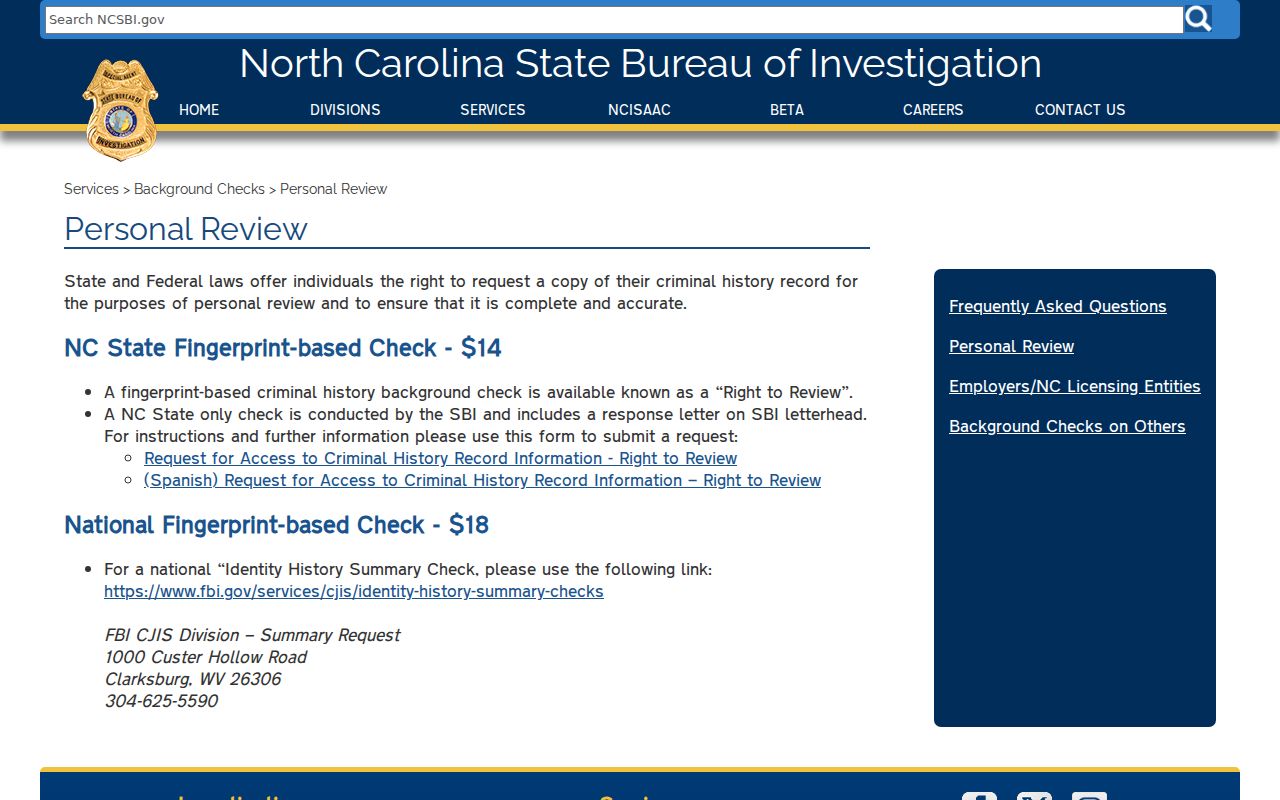
The source makes the limited scope clear: this is the subject's fingerprint-linked North Carolina repository record, not a public people-search system.
Dare County Fingerprint Record Review
Ask a local law-enforcement agency to roll a complete FD-258 card. SBI stopped supplying blank cards to applicants, so call Dare Sheriff, Kill Devil Hills Police, Nags Head Police, or Kitty Hawk Police first. No current official Dare page publishes a fixed appointment system or local fingerprint fee. That gap should be handled with a phone call, not an assumed vendor or price.
Mail the signed application, the card, and payment to NCSBI-CIIS, Attn: NICS/CCH Unit Supervisor, 3320 Garner Road, P.O. Box 29500, Raleigh, NC 27626-0500. The form seeks names and aliases, birth information, descriptive identifiers, mailing details, signature, and the fingerprint enclosure. If the returned history contains an error, submit the written exception form with the event in dispute and court or agency proof. SBI coordinates with the source; it cannot casually rewrite a court judgment.
Record flow: Dare arresting agency › Detention fingerprints › SBI arrest cycle › clerk disposition report › subject Right to Review.
Criminal Record Types
An incident report describes what an agency received or investigated. A booking record tracks jail intake and custody. The clerk's case file shows filed charges, events, outcomes, and judgments. SBI organizes fingerprint-supported arrest cycles with dispositions reported back to the repository. NCDAC separately covers state prison and community supervision. A registry profile follows a qualifying conviction and registration duty.
- Incident or arrest report: held by the sheriff, town police, trooper, or federal agency that created it.
- Booking and custody record: held by Dare County Detention for local jail intake and release status.
- Court case file: held by the Dare Clerk, with eCourts providing a public case summary.
- Repository history: held by SBI and tied to fingerprints received from contributing agencies.
- Corrections or registry record: held by NCDAC or the SBI registry for its distinct public purpose.
Warrants are another special category. No complete official public active-warrant database was found for Dare County. Confirm possible process with the Sheriff, Clerk, or Magistrate because a blotter or public court search can lag.
Four Dare County Records Compared
A common search error is treating the jail, court, SBI, and NCDAC records as one criminal history. They overlap but use different dates, identifiers, and status terms. The best source changes as a matter moves from arrest through court and, in some cases, into state custody or supervision.
| Record | Best use | Key limit |
|---|---|---|
| Dare booking record | Current local custody, charge and bond | Not a court outcome |
| Dare court file | Filed charges, hearings, disposition and judgment | One case or county court system |
| SBI history | Your fingerprint-linked North Carolina arrest cycles | Only data reported to SBI |
| NCDAC locator | State prison, probation, parole and releases | Excludes Dare County jail |
A released person may vanish from a current jail inquiry yet later appear in a court case or NCDAC search. Likewise, a case can be dismissed even though an older arrest record remains until an eligible expunction is granted.
Inside a Dare County Criminal Record
Read each record according to its purpose. A repository history starts with identity data and then groups events into arrest cycles. A court record emphasizes its case number, filed counts, hearings, judgment, costs, and sentence. Booking data focuses on intake, the arresting agency, current charges, bond, custody status, and release. The same event may look different across all three.
| Name and identifiers | Current and alias names, birth data, descriptors, and fingerprint-linked state identifiers where authorized. |
|---|---|
| Arrest and booking | Arrest date, agency, booking time, custody ID, charge and bond fields. |
| Charges and statutes | Offense text, class, alleged date, process number, and count sequence. |
| Disposition | Pending, dismissal, plea, finding, conviction, acquittal, and judgment date by count. |
| Sentence | Custody, probation, fines, costs, restitution, and other ordered terms when public. |
| Supervision status | State prison, probation, parole, post-release, absconder, or release data in NCDAC. |
“Disposition” means the outcome of a count. “Pending” is only a status. A dismissal is not a conviction, but it also does not mean every government record has already been erased.
Dare County Booking and SBI Records
An officer creates the first incident or arrest report. Dare Detention then records intake details, takes a photograph and fingerprints, lists charges and bond, and conducts its safety screening. The colocated magistrate handles early judicial process and release conditions. When charges are filed, the clerk opens the case trail. Fingerprint data may form an SBI arrest cycle, while later court dispositions must be matched back to it.
This chain explains why an SBI record can lack a final outcome. The repository may have received the arrest card but not a matching disposition, or the link may be delayed. Compare a questionable cycle with the Dare court judgment and use the SBI written-exception process for your own record. Do not infer guilt from the unmatched arrest entry.
The official Dare County Justice Center page shown here identifies the court site that holds the filed case record.
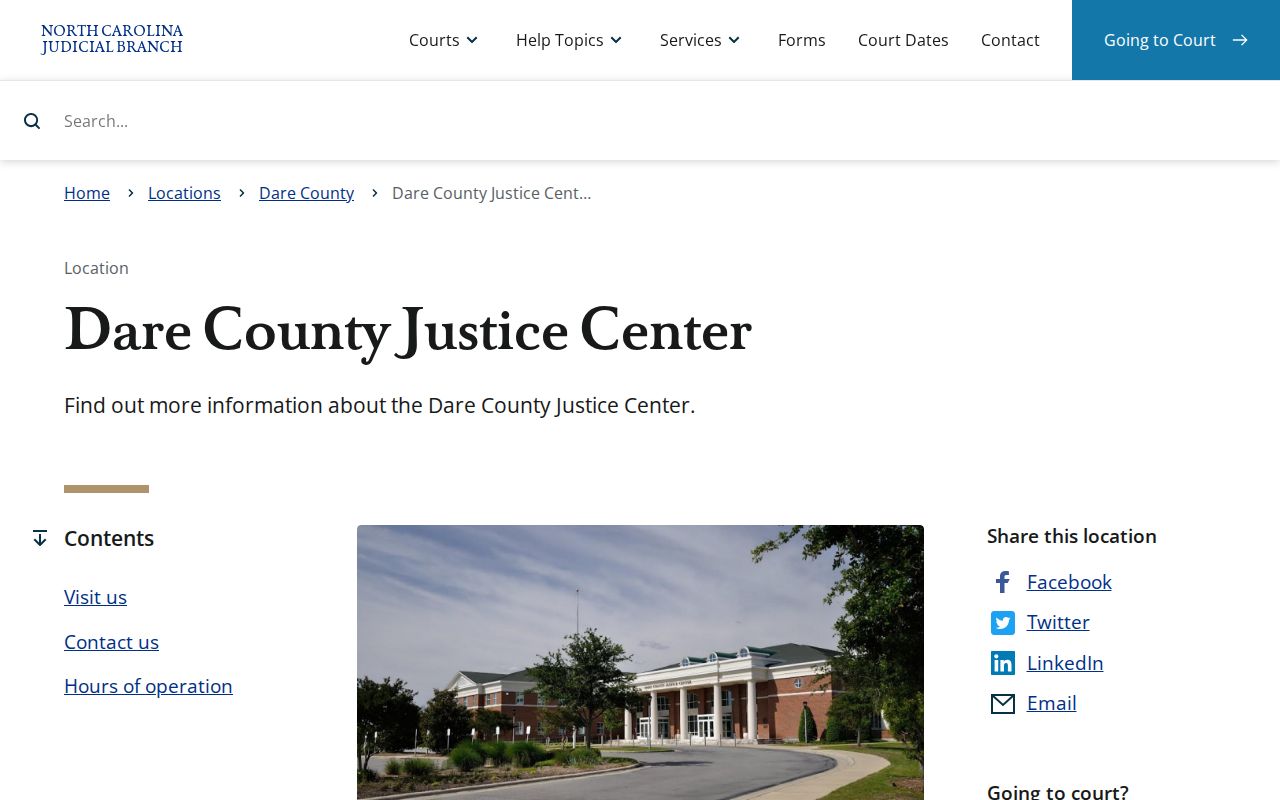
The clerk's file supplies the disposition and judgment when a jail or repository entry does not tell the full story.
Public Access Laws in North Carolina
The North Carolina Public Records Law starts with broad access to records made or received in public business, but criminal files have important limits. Investigation and intelligence records are not open as a whole. Certain incident, complaint, and arrest facts have a public-access rule, subject to court-ordered withholding. Ask for the precise public portion and expect protected victim, juvenile, informant, and active-investigation details to be withheld or redacted.
Key statutes:
G.S. 132-1 defines public records made or received in public business.
G.S. 132-1.4 separates public incident and arrest facts from protected investigation material.
G.S. 132-6 governs inspection and copies at reasonable times under supervision.
G.S. 15A-151 makes expunction files confidential except for limited authorized access.
Chapter 132 does not turn confidential SBI repository data into a public name search. The Right to Review and other authorized fingerprint channels control access to that material.
Dare County Criminal Record Custodians
Several key offices sit near one another in Manteo, yet each controls different records. The clerk has court files and expunction petitions. Detention maintains booking and current custody data. The Sheriff keeps its own public arrest and incident information. County Public Relations handles general county requests but expressly routes court questions to the clerk and Sheriff records to the Sheriff.
Dare County Clerk
962 Marshall C. Collins Drive, Manteo, NC 27954
252-475-5200
Court files, terminals, name checks, copies, and expunction filings.
Dare County Detention
1044 Driftwood Drive, Manteo, NC 27954
252-475-9220
Current jail custody and booking questions.
Dare County Sheriff
P.O. Box 757, Manteo, NC 27954
252-475-5980
Sheriff incident, arrest, warrant-channel, and registry questions.
County Public Information
954 Marshall C. Collins Drive, Suite 111, Manteo, NC 27954
252-475-5903
General county records, not Sheriff or court files.
Call before travel. Court schedules and holiday closures change, and Hatteras Island residents face a long trip to the county seat. A narrow request with date, place, agency, report number, and requested public portion is easier to route.
Sealed, Expunged, and Restricted Records
North Carolina uses “expunction” for the court process that seals or destroys eligible state arrest, charge, and conviction records. Juvenile matters, confidential SBI data, sensitive victim identifiers, and nonpublic investigative details also have access limits, but those limits come from different laws. Redaction hides selected data in an otherwise public record. Expunction removes an eligible matter from ordinary public government access after a court order.
Eligibility depends on the exact outcome, offense, history, and statute. Some dismissed or not-guilty charges and certain nonviolent convictions may qualify. G.S. 15A-145.5 has major exclusions, including specified felony classes, Class A1 misdemeanors, assault-element offenses, registry offenses, and other listed crimes. A docket label alone cannot resolve eligibility.
The North Carolina expunction page shown here links the official forms and filing process.
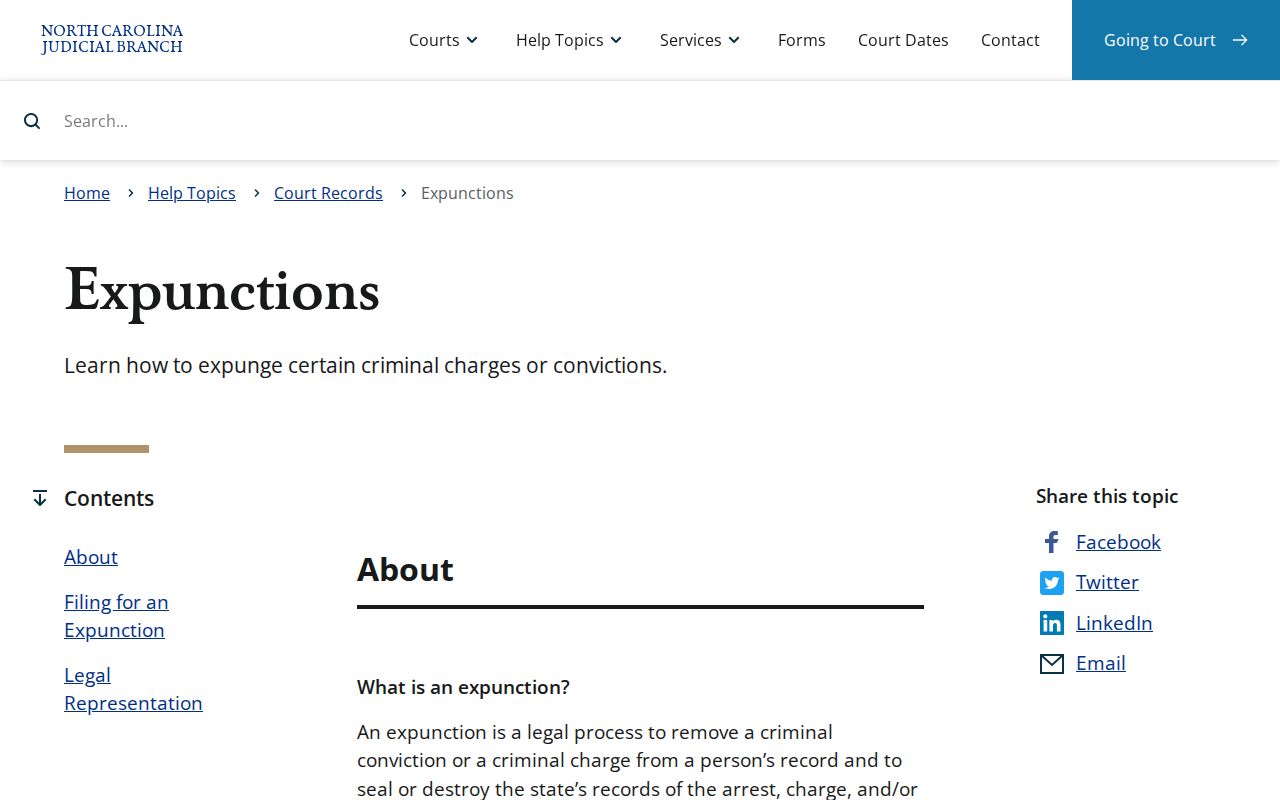
The petition is filed with the clerk in the county of charge or conviction, which means the Dare Clerk for a Dare case.
Dare County Expunction Record Steps
First identify the outcome and the statute that may apply. Obtain the matching AOC petition and instructions, collect any required affidavits or checks, then file at the Dare County Justice Center. The general filing fee is $175. Dismissed or not-guilty petitions commonly have no fee unless the dismissal followed diversion or deferred prosecution. An indigency form may be available where allowed.
Agency checks, prosecutor review, notice, and a hearing can make processing last several months. After entry, agencies receive the order and ordinary Portal visibility ends. Keep the signed order. The clerk warns that it may not be able to reproduce a destroyed expunction file later. For petitions filed on or after December 1, 2017, AOC provides a route to request a certificate verifying a prior expunction.
Note: If a Judicial Branch search still shows the case after several weeks, contact the Dare Clerk that granted the order.
Dare County Jail and Supervision Records
No stable official Dare County web jail-roster form was located. For present custody, call Detention at 252-475-9220. The Sheriff's monthly blotter is a selective enforcement news archive, not a full roster. NC SAVAN can provide custody and status notifications. A person transferred into the state system may then appear in the NCDAC Offender Locator.
The NCDAC Offender Locator shown here searches state prisoners and community supervision records.
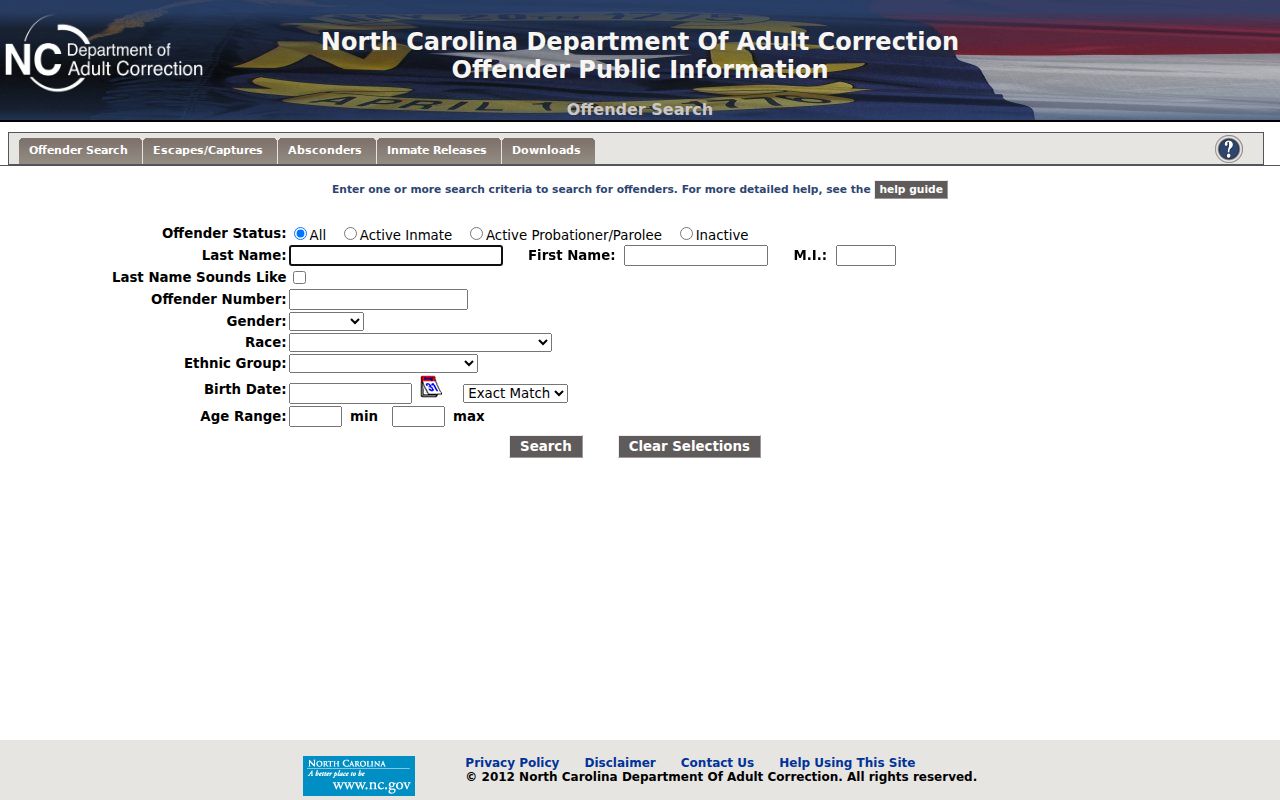
Its scope includes prisoners, probationers, parolees, releases, absconders, and historical records back to 1972, but it excludes Dare County jail inmates.
- Probation
- A court-ordered community sentence or supervision term.
- Post-release supervision
- Statutory supervision after release from prison for covered cases.
- Parole
- Conditional release that applies to eligible legacy or special sentences.
- Absconder
- A supervised person alleged to have evaded supervision.
NCDAC Community Supervision, not Dare County, runs adult probation, parole, and post-release work. Court records show the signed sentence or violation order; the locator shows public corrections status.
Dare County Coastal Criminal Records
Dare County stretches along Roanoke Island and the Outer Banks. An incident may belong to a town police department, the Sheriff's Office in an unincorporated area, the State Highway Patrol on a highway, or National Park Service rangers on federal land. The person may still be booked at Dare Detention, while the incident report remains with the arresting agency and a federal case never enters Dare state court.
Use the location and responding officer's agency to find the report. Town cases proceed through Dare District or Superior Court because North Carolina has no separate municipal criminal courts in Kill Devil Hills, Kitty Hawk, or Nags Head. Federal dockets for this county belong to the U.S. District Court for the Eastern District of North Carolina and use PACER. This split makes the originating agency more useful than a broad request sent to the wrong office.
The NCDAC search-options page shown here also separates prison, community supervision, notification, and interstate tools.
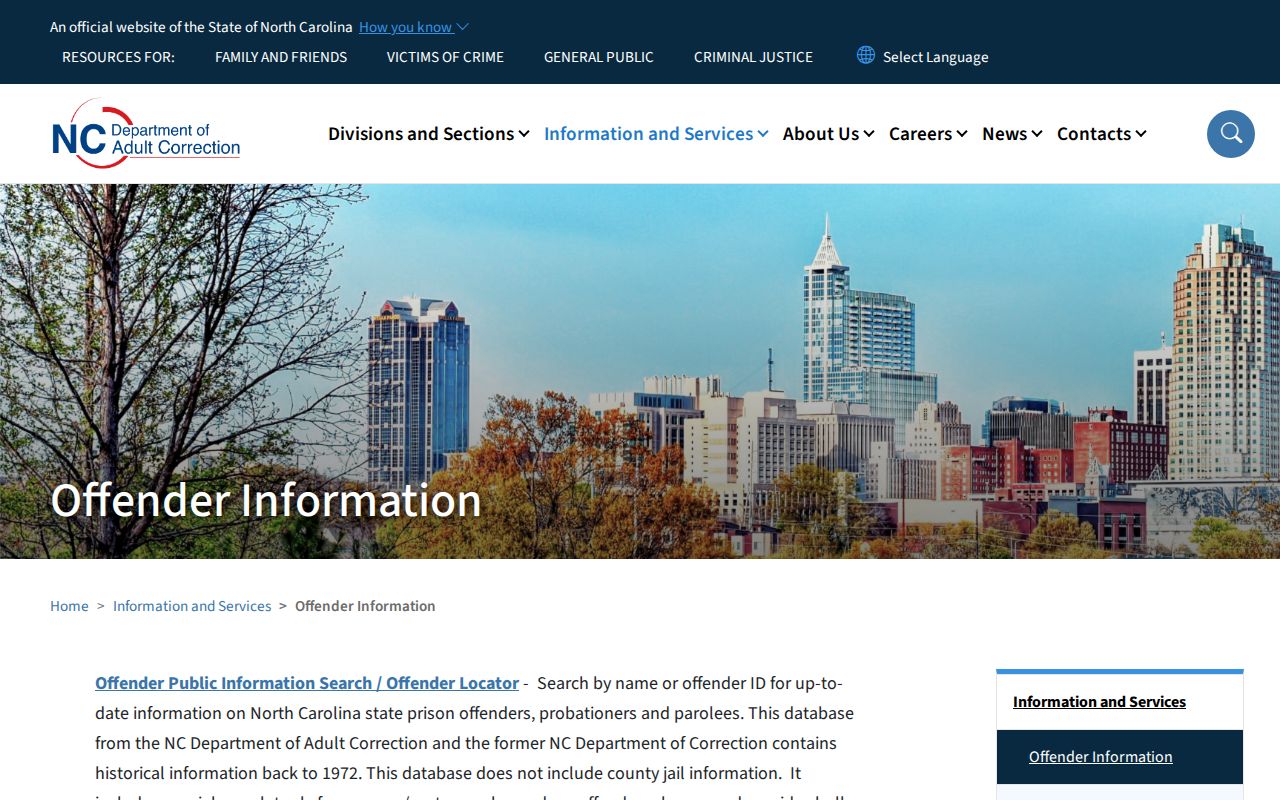
That division reinforces the main rule: custody, court, repository, and supervision records answer different questions.
Dare County Criminal Records by City
Kill Devil Hills, Kitty Hawk, and Nags Head are Dare County's three largest incorporated towns by the research ranking. Each police department keeps the reports it creates, but none has a separate municipal criminal court. Arrests that require custody go to Dare Detention, and filed charges move through the state District or Superior Court system in Manteo. Begin with the town for its incident report, then move to the county custodian for booking, case, and outcome records.
Kill Devil Hills Criminal Records
Police reports use a $5 online form; court questions route to the Dare Clerk.
Kitty Hawk Criminal Records
Police Records accepts incident requests, while NCDMV supplies crash reports.
Nags Head Criminal Records
Police reports cost $5 and the town also provides a public-record form.
These city routes matter because the Dare Sheriff cannot produce a report that a town police officer created. The court and jail layers remain countywide after the local agency step.